
P-SHIELD® EMI Shielding and Grounding Materials Selection Guide
As electronic systems become smaller, faster, and more densely integrated, controlling electromagnetic interference (EMI) and maintaining reliable electrical grounding become increasingly important design considerations. Material selection can affect not only shielding performance, but also electrical contact, available assembly space, mechanical compliance, adhesion, and manufacturability.
Since 1998, Polymer Science has developed engineered material solutions for electronics and other demanding applications. Our experienced engineering, technical, and converting teams work with OEMs and manufacturers to identify electrical, mechanical, and manufacturing requirements and develop material solutions that can be integrated effectively into the final assembly.
Explore P-SHIELD® EMI Shielding and Grounding Materials
The P-SHIELD® EMI Shielding and Grounding Materials Selection Guide provides a consolidated reference for comparing Polymer Science’s portfolio of materials designed for EMI shielding, electrical grounding, and related electronic assembly requirements.
Selecting the appropriate material requires more than identifying the product with the lowest electrical resistance. Engineers must consider the complete interface, including available space, electrical performance, compression, surface geometry, bonding requirements, environmental conditions, and the type of conductive path required by the assembly.
The P-SHIELD® portfolio includes:
- Conductive foam tapes for applications requiring electrical conductivity combined with compression, conformability, and gap accommodation.
- Conductive fabric and fabric tapes for thin, flexible shielding and grounding applications.
- Conductive adhesives for applications requiring mechanical attachment combined with an electrically conductive interface.
- Heat-activated conductive materials for applications requiring an alternative to pressure-sensitive adhesive attachment.
- Copper tapes and foils for thin conductive shielding and grounding constructions.
- Nickel tapes and foils for additional conductive material and construction options.
- Supporting non-conductive materials and elastomers for complementary insulation, cushioning, bonding, and mechanical requirements within electronic assemblies.
The Selection Guide allows engineers to compare available P-SHIELD® materials using relevant properties such as thickness, material construction, surface resistivity, Z-axis resistance, adhesive peel force, shielding effectiveness, and hardness where applicable.
For a detailed comparison of available products and properties, download the complete P-SHIELD® EMI Shielding and Grounding Materials Selection Guide.
Selecting an EMI Shielding or Grounding Material
Selecting the appropriate EMI shielding or grounding material requires evaluating the electrical, mechanical, and assembly requirements of the complete application. Properties such as surface resistivity, Z-axis resistance, shielding effectiveness, thickness, conformability, and attachment method can influence material selection.
Surface Resistivity
Surface Resistivity is used in the P-SHIELD® Selection Guide to characterize resistance to electrical current flow along the surface of a material and is reported in ohms per square (Ω/sq). Lower reported values generally indicate a more conductive surface. For EMI shielding and grounding applications, this property can be useful when comparing the electrical characteristics of conductive foams, fabrics, tapes, adhesives, and metallic materials.
Z-Axis Resistance
Z-axis resistance measures electrical resistance through the thickness of a material. This property is particularly relevant when a conductive material is positioned between two surfaces to establish an electrical path through the interface. Material construction, contact conditions, compression, and the interfaces within the completed assembly can influence the resulting electrical resistance.
Shielding Effectiveness
Shielding effectiveness describes the reduction in electromagnetic energy provided by a shielding material or system under specified test conditions and is commonly expressed in decibels (dB). Measured shielding effectiveness can depend on frequency, test method, material construction, and test configuration. In a completed electronic assembly, overall shielding performance can also be influenced by seams, openings, grounding, interfaces, enclosure design, and other system-level factors.
Material Thickness
Available space is often a critical constraint in electronic assemblies. P-SHIELD® materials are available in constructions ranging from thin conductive adhesives, fabrics, and metal foils to thicker conductive foam materials. Appropriate material thickness depends on the available gap, required electrical contact, dimensional tolerances, compression requirements, and overall assembly configuration.
Compression and Conformability
Conductive foam materials can combine electrical conductivity with mechanical compliance, allowing the material to accommodate gaps, surface variation, and dimensional tolerances. Compression can help the material conform to mating surfaces and maintain electrical contact within the assembly. Material thickness, hardness, compression, and the mechanical limits of surrounding components should be considered when evaluating a conductive foam construction.
Adhesive and Attachment Method
Attachment method is an important consideration when integrating shielding and grounding materials into an assembly. The P-SHIELD® portfolio includes pressure-sensitive adhesive constructions, conductive pressure-sensitive adhesives, heat-activated materials, double-coated constructions, and materials supplied without adhesive. Selection should consider the required electrical path, substrate, assembly process, environmental conditions, mechanical requirements, and whether conductivity is required through the bonded interface.
From Material Selection to Production
Selecting an appropriate shielding or grounding material is only part of developing an effective solution. The material must also integrate with the electrical, mechanical, dimensional, and manufacturing requirements of the completed assembly.
Polymer Science works with customers from initial material selection through development, validation, converting, and commercialization. This collaborative process helps translate application requirements into a material construction that can be manufactured consistently and integrated into the customer’s production process.
- Define Application Requirements: Identify the electrical, mechanical, dimensional, environmental, and manufacturing requirements of the application.
- Select and Evaluate Materials: Compare available P-SHIELD® technologies and identify candidate materials based on the required shielding, grounding, mechanical, and attachment characteristics.
- Prototype and Test: Evaluate candidate materials within the intended assembly and verify that the selected construction meets the application’s functional requirements.
- Convert for the Application: Develop the required material configuration using converting capabilities such as precision slitting, laminating, and die cutting where applicable.
- Commercialize and Support: Transition the approved construction into production and provide ongoing technical, quality, and manufacturing support.
Get the Complete P-SHIELD® Selection Guide
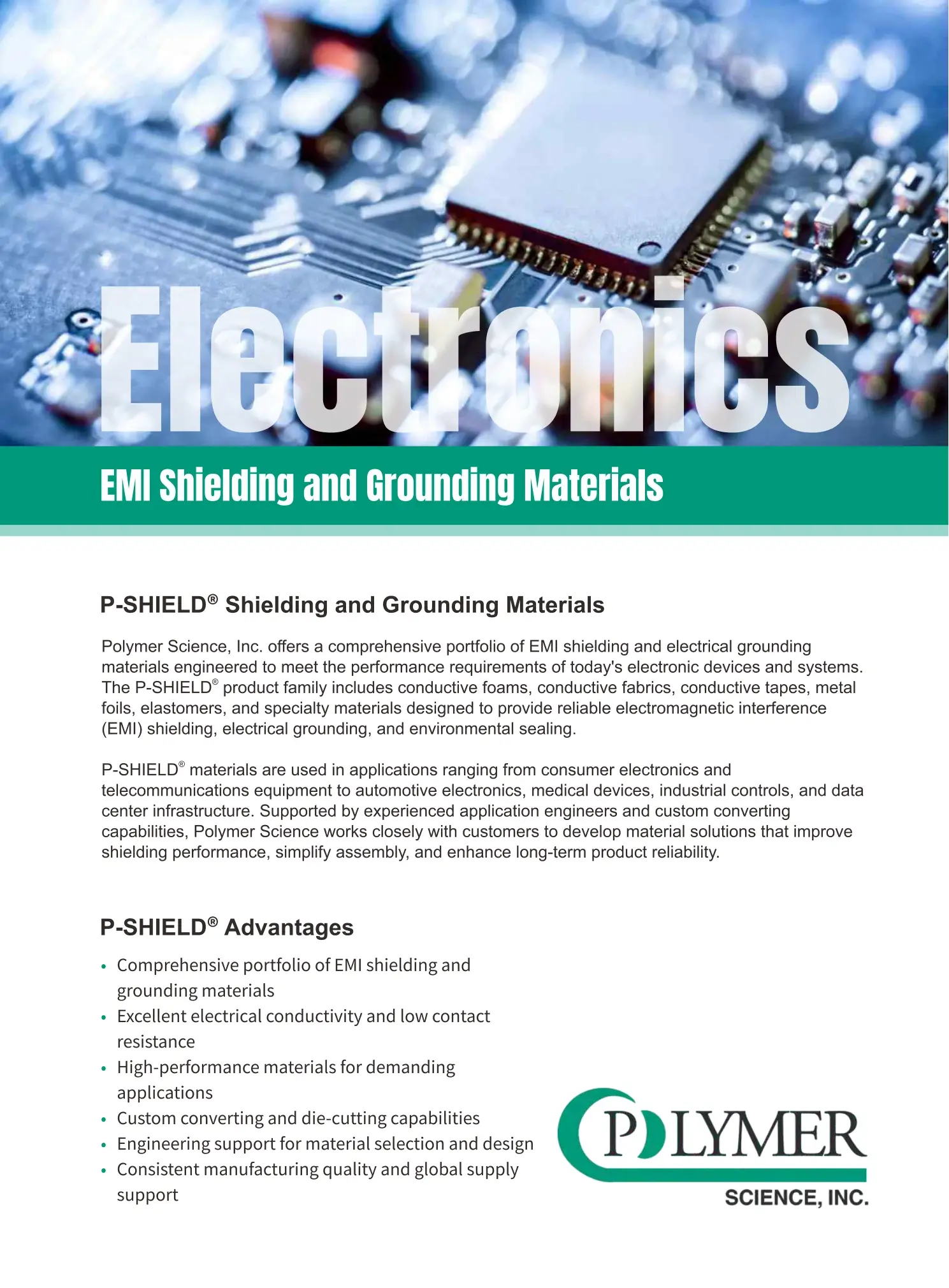
The complete P-SHIELD® EMI Shielding and Grounding Materials Selection Guide provides detailed product information to help engineers compare available material technologies and identify candidates for further evaluation.
Compare materials by construction, thickness, surface resistivity, Z-axis resistance, adhesive peel force, shielding effectiveness, hardness, and other application-specific properties where applicable.
Frequently Asked Questions
What is the difference between EMI shielding and grounding?
EMI shielding is used to reduce electromagnetic energy entering or leaving a protected region or electronic assembly. Grounding establishes an electrically conductive path between components or to a common electrical reference. The two functions are related but are not interchangeable. Depending on the material construction and system design, a conductive material may contribute to both shielding and grounding performance.
What is surface resistivity?
Surface resistivity is used in the P-SHIELD® Selection Guide to characterize resistance to electrical current flow along the surface of a material and is reported in ohms per square (Ω/sq). It is one electrical property that can be considered when comparing conductive materials for shielding and grounding applications.
What is Z-axis resistance?
Z-Axis Resistance describes electrical resistance through the thickness of a material. It is particularly relevant when a conductive material is positioned between two surfaces and is intended to establish an electrical connection through the interface.
When should conductive foam be considered?
Conductive foam can be considered when an application requires electrical conductivity combined with mechanical compliance. The foam can compress to accommodate gaps, dimensional variation, and surface irregularities while helping maintain electrical contact between mating surfaces. Thickness, hardness, compression, and available assembly space should also be considered.
When should conductive fabric be considered?
Conductive fabric can provide a thin, flexible conductive layer for EMI shielding and grounding applications. Depending on the application and material construction, conductive fabric can be used without adhesive or incorporated into an adhesive-backed tape construction.
When should a conductive adhesive be considered?
A conductive adhesive can be considered when an assembly requires both mechanical attachment and an electrical connection through the bonded interface. Material thickness, electrical resistance, substrate compatibility, bond requirements, environmental conditions, and the required direction of conductivity should be considered for the specific application.
Is the material with the lowest electrical resistance always the best choice?
No. Electrical resistance is only one consideration when selecting an EMI shielding or grounding material. Material thickness, shielding requirements, mechanical compliance, compression, attachment method, substrate compatibility, environmental conditions, available space, manufacturing requirements, and the design of the completed assembly can also influence material selection and system performance.
Frequently Used Terms
EMI — Electromagnetic Interference: Electromagnetic energy that can interfere with the intended operation of electronic equipment or systems.
EMC — Electromagnetic Compatibility: The ability of electronic equipment or systems to operate as intended within their electromagnetic environment without causing or experiencing unacceptable electromagnetic interference.
Shielding Effectiveness: A measure of the reduction in electromagnetic energy provided by a shielding material or system under specified test conditions, commonly expressed in decibels (dB).
Surface Resistivity: A property used in the P-SHIELD® Selection Guide to characterize resistance to electrical current flow along the surface of a material, reported in ohms per square (Ω/sq).
Z-Axis Resistance: Electrical resistance measured through the thickness of a material.
PSA — Pressure-Sensitive Adhesive: An adhesive that forms a bond to a substrate through applied pressure without requiring heat activation.
cPSA — Conductive Pressure-Sensitive Adhesive: A pressure-sensitive adhesive formulated or constructed to provide electrical conductivity through the bonded interface.
HAF — Heat-Activated Film: An adhesive film designed to develop its bond through the application of heat, typically in combination with pressure, under specified processing conditions.
Need Help Selecting an EMI Shielding or Grounding Material?
Polymer Science’s engineering and technical teams can help evaluate your electrical, mechanical, dimensional, and manufacturing requirements to identify P-SHIELD® materials for further evaluation.